Bending Without Breaking: Understanding Psychological Flexibility
Life rarely goes exactly according to plan. Whether it is a sudden change in our career, relationship struggles, or simply the daily stress of being human, we are constantly asked to adapt.
In my practice, I often use a model from Acceptance and Commitment Therapy (ACT) to help clients navigate these waters. It is called the Hexaflex.
At its core, the Hexaflex helps us develop Psychological Flexibility: the ability to stay open, adaptable, and effective even when difficult emotions or thoughts show up. Instead of snapping under pressure, psychological flexibility allows us to bend, adjust, and continue moving toward a meaningful life.
Here is a breakdown of the two sides of this coin: The Hexaflex (where we want to go) and the Counter-Hexaflex (where we often get stuck).
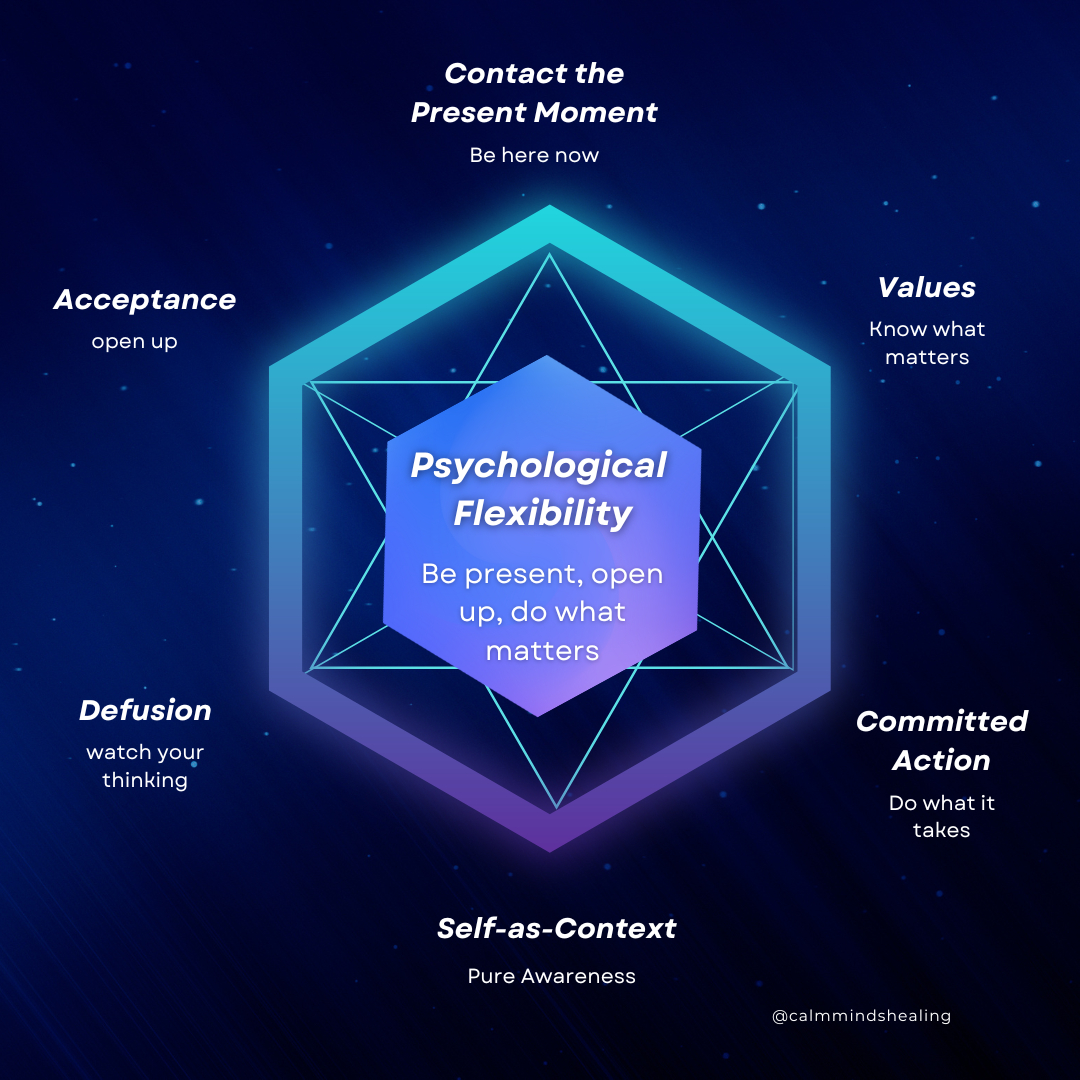
The Hexaflex
The Hexaflex: Six Pillars of a Flexible Mind
When we are operating with psychological flexibility, we aren't ignoring our problems; we are relating to them differently. The Hexaflex is composed of six core principles that work together:
Cognitive Defusion: This is the practice of "stepping back" from our thoughts. Instead of getting tangled up in a thought like "I’m not good enough," we learn to look at the thought rather than from it. We see thoughts as passing events, not absolute truths.
Acceptance: This doesn't mean "giving up." It means making room for unwanted feelings, sensations, or urges without struggling to change or avoid them. It is dropping the tug-of-war rope with your emotions.
Contact with the Present Moment: This is the "Be Here Now" component. It involves fully engaging with the here and now with openness and curiosity, rather than getting lost in the past or worrying about the future.
The Observing Self (Self-as-Context): This is the understanding that you are not your thoughts, feelings, or roles. You are the "sky" that holds the weather. The weather (your emotions) changes constantly, but the sky (the part of you observing it) remains distinct and constant.
Values: These are your heart's deepest desires for how you want to behave as a human being. Unlike goals, which can be checked off a list, values are a compass direction (like "being a loving parent" or "prioritizing creativity") that guides your path.
Committed Action: This is where the rubber meets the road. It means taking effective action guided by your values, even when difficult thoughts or feelings arise. It is moving your feet in the right direction, even if your mind is chatting nervously.
The Counter-Hexaflex: Where We Get Stuck
We all have moments where we feel rigid, stuck, or overwhelmed. In ACT, we map this using the Counter-Hexaflex. These aren't "failures"; they are simply the unhelpful patterns that contribute to psychological distress.
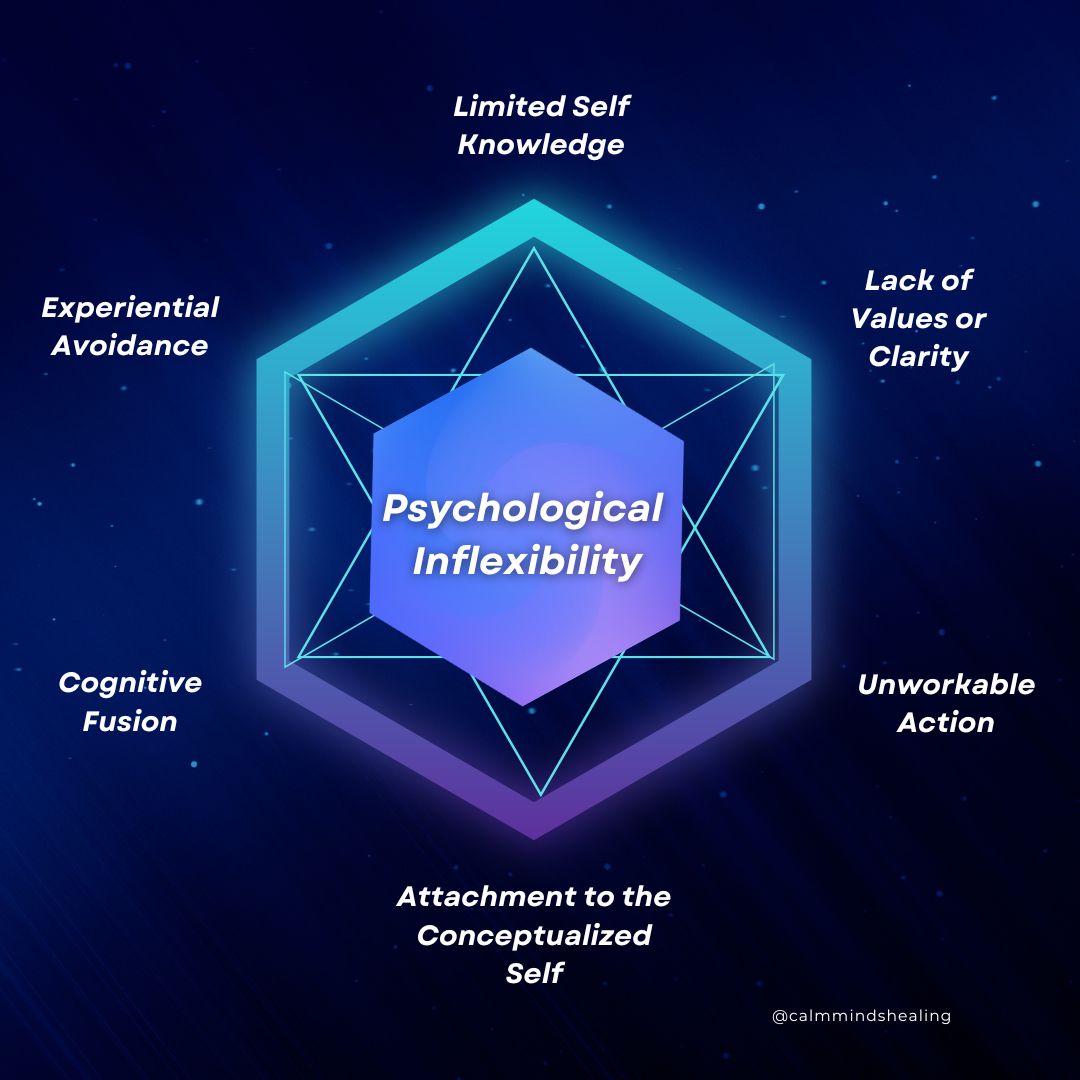
The Counter Hexaflex
The Six Components of Psychological Inflexibility:
When we are psychologically inflexible, we tend to fall into these six traps:
Cognitive Fusion: Becoming overly attached or "fused" with thoughts. We treat a thought like "I'm a failure" as a solid fact that dictates our reality and behavior.
Experiential Avoidance: The struggle to avoid, suppress, or escape unwanted internal experiences. While this might bring short-term relief, it often shrinks our world and prevents us from doing what matters.
Limited Self-Knowledge (Attachment to Self): Identifying strictly with labels ("I am an anxious person," "I am a victim"). When we cling to these stories, we lose touch with the broader, capable self underneath the labels.
Dominance of the Past or Future: Living in a time zone other than "now." This looks like rumination on past mistakes or chronic worry about future catastrophes, causing us to miss the life happening right in front of us.
Lack of Values Clarity: Feeling lost, aimless, or operating on "autopilot." Without a clear compass, we often make decisions based on what will avoid pain rather than what will bring fulfillment.
Inaction or Unworkable Action: Staying in the comfort zone, procrastinating, or acting impulsively to get rid of difficult feelings. This often leads to patterns that move us further away from the life we want.
Moving from Rigid to Flexible
The goal of ACT is not to delete the Counter-Hexaflex from your brain—that is impossible! The goal is to notice when you have drifted into those rigid patterns and gently guide yourself back toward the Hexaflex.
Unlike other modalities like CBT, which may focus on challenging or changing thoughts, ACT encourages a shift in relationship. We don't need to silence our inner critic to live a good life; we just need to learn how to lower the volume so we can hear our own values more clearly.
By practicing these six skills, we build a mind that is less like glass (easily shattered by stress) and more like bamboo—strong, rooted, and capable of weathering the storm.